01
Footing the steps on a graded base
Steps begin on a real footing set on a base built for Clermont's sloped, sandy ground, so they don't settle or walk off the house as the soil works through wet and dry spells.
Steps that hold their line on Clermont's sloped, sandy ground: even risers, fiber and mesh reinforcement, a tie-in that stays anchored, and a surface that keeps your footing when the afternoon storm rolls through.
Credibility comes from how it's built, not from promises. Here's the order of operations on every concrete steps & stairs job.
Steps begin on a real footing set on a base built for Clermont's sloped, sandy ground, so they don't settle or walk off the house as the soil works through wet and dry spells.
We hold every riser to the same height and inside code so the climb stays predictable, steady and safe with each step you take.
We reinforce the pour with structural fiber and welded wire mesh so the steps keep their edges and corners as the sandy soil over clay shifts beneath them, the standard Florida approach in no-freeze ground rather than a heavy rebar grid.
A broom or textured surface keeps your footing through Central Florida's frequent rain and humid mornings, and we work in extra grit wherever the entry calls for it.
We knit the new steps into the porch, slab, or walkway they meet so the finished entry reads as one continuous piece rather than a patch.
Most contractors vanish after the deposit. We pick up the phone, show up when we say, and stand behind the work after the truck leaves. The follow-through is the difference.
A foreman we know runs your job and a vetted crew does the work, managed by Lucky's, one company accountable from the first call to the final walkthrough.
COI and lien waivers on file before we break ground. The documentation that lets commercial clients pay and gives homeowners peace of mind.
Prepped subgrade, reinforced and mixed to spec for the job, and proper curing. We build credibility through the process, not promises. On concrete steps & stairs, that starts with footing the steps on a graded base.
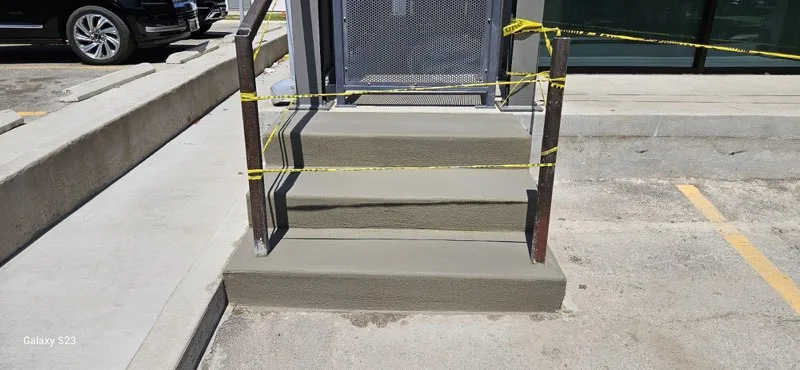
We price steps by the set rather than the square foot, and the cost tracks the riser count, the footing and base work the slope demands, and how the run meets the house. As a starting range, a typical set tends to run about $300 to $500 per step. You get a firm number once we have looked over the entry.
Most often the footing sat on sandy ground that was never properly graded or compacted, so it settled and walked the steps off the house over the years, and a sloped lot only speeds that along. We set footings on a base built to stay anchored and reinforce the pour so it holds together.
Every riser comes in at the same height and within local code so no single step lands short or tall underfoot. A mismatched riser is both awkward to climb and a place to catch a toe, and that hazard sharpens once Central Florida rain leaves the tread slick.
It hinges on what failed. Surface chips and a bit of spalling will often take a patch, but once steps have settled or pulled loose from the house the cause is usually down in the base, and that calls for a rebuild. We tell you plainly which case you are in.
We form and finish the steps and cast in the anchor points a railing needs, then line up the railing install so the entry lands where you want it for access and safety.
Give them a few days of curing before light use while the concrete gains strength, and expect that window to stretch a touch in Clermont's heavy summer humidity. We hand over the dates for your specific pour before we start.
You'll hear back from a real person, usually the same day. No call center, no runaround, no chasing us down.
Booking up fast this season. Or call (352) 717-9913